

Friction Mapping: The Physics of Behaviour Change - Event recording
Treating behaviour change as a systems problem rather than a persuasion problem.
We are joined by Justin Balaski, the owner of IdeaLeap and Lean Change and the creator of Friction Mapping, a change management method that treats behaviour change as a systems problem rather than a persuasion problem. He works with organisations to diagnose why changes stall and to build the conditions where new behaviours become the path of least resistance.
The slogan to hold onto throughout is a simple one. Make it easier to do the new thing, make it harder to do the old thing.
Behaviour follows the path of least friction
Human behaviour, absent force or other reasons, looks for the path of least friction, and over time that creates ways of working, doing and being.
A personal example makes the point. Working from home means the fridge is four metres away, just outside the office. When it broke, the food moved to the fridge in the garage, roughly eight metres away, out the side door and around the corner. In the week before the replacement arrived, six pounds, three kilos, disappeared. Nobody said eat less. What changed was the condition of the environment.
Behaviour changes when the environment changes
Environments have an outsized impact on behaviour. We hear a great deal about systems thinking, design thinking and behavioural science, and it becomes nebulous. How do we actually do that?
Imagine you are an office manager. Busy office, snacks coming out of the vending machine, and you would like the team to eat more fruit. The common answers are to put out a fruit bowl and to move the vending machines away. The first makes the new thing easier. The second makes the alternative more difficult. So the fruit bowl goes in. Now, which one do you reach for?
What matters is the type of fruit you put in there, and the banana is the king of all fruits. Grapes mean a trip to the office washroom, using the sink, then drying them. That is a lot of friction. A banana can be grabbed and peeled. It is self contained and nobody has touched it.
Friction is the most powerful lever you have
If you want to change the environment, the most powerful lever you have to shape conditions is friction. Full stop. Our weakest levers are push communications and training.
F = f(E, C)
Friction is a function of effort and cognitive load.
This is a conceptual equation, not a mathematical one. Effort is how physically difficult or demanding something is, the steps and the process. Cognitive load is how complex it is, how nebulous, how uncertain, and how emotionally attached we are to things.
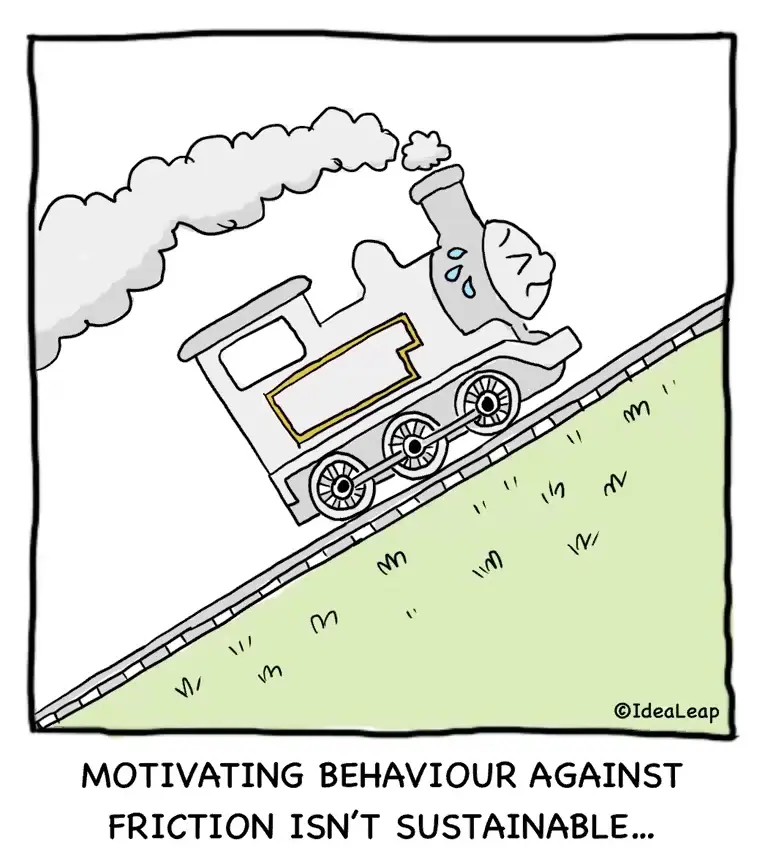
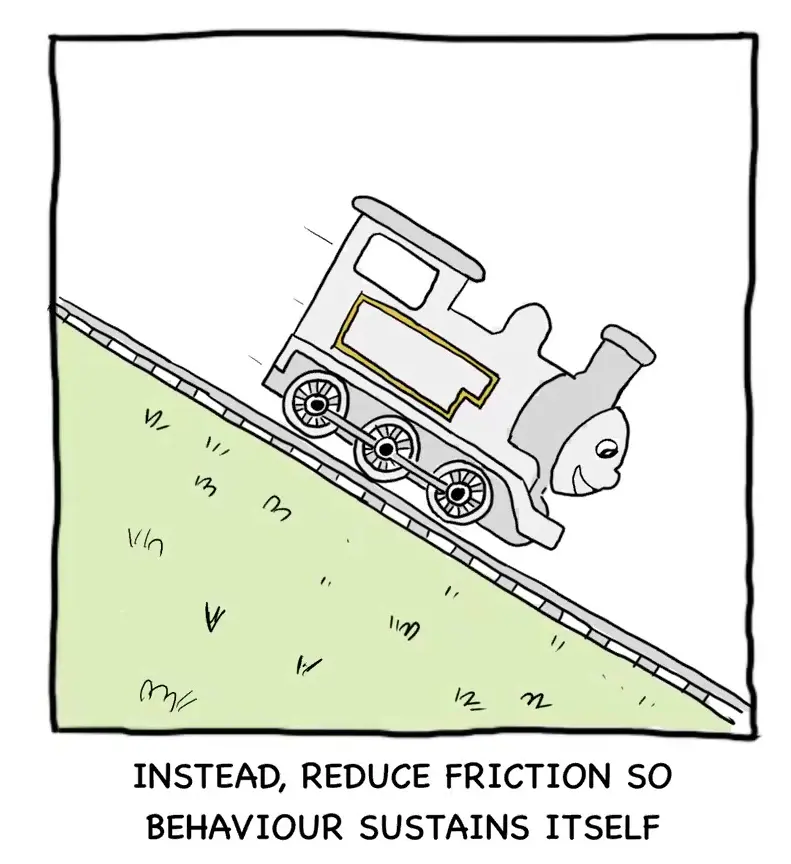
Most change efforts focus on motivation, the push. The problem is that friction compounds daily, while motivation has to be renewed daily. Motivating people against friction over the long term does not hold, and they will find ways around it if they can. Remove the friction instead, so the behaviour sustains itself.
The world's simplest behaviour change framework
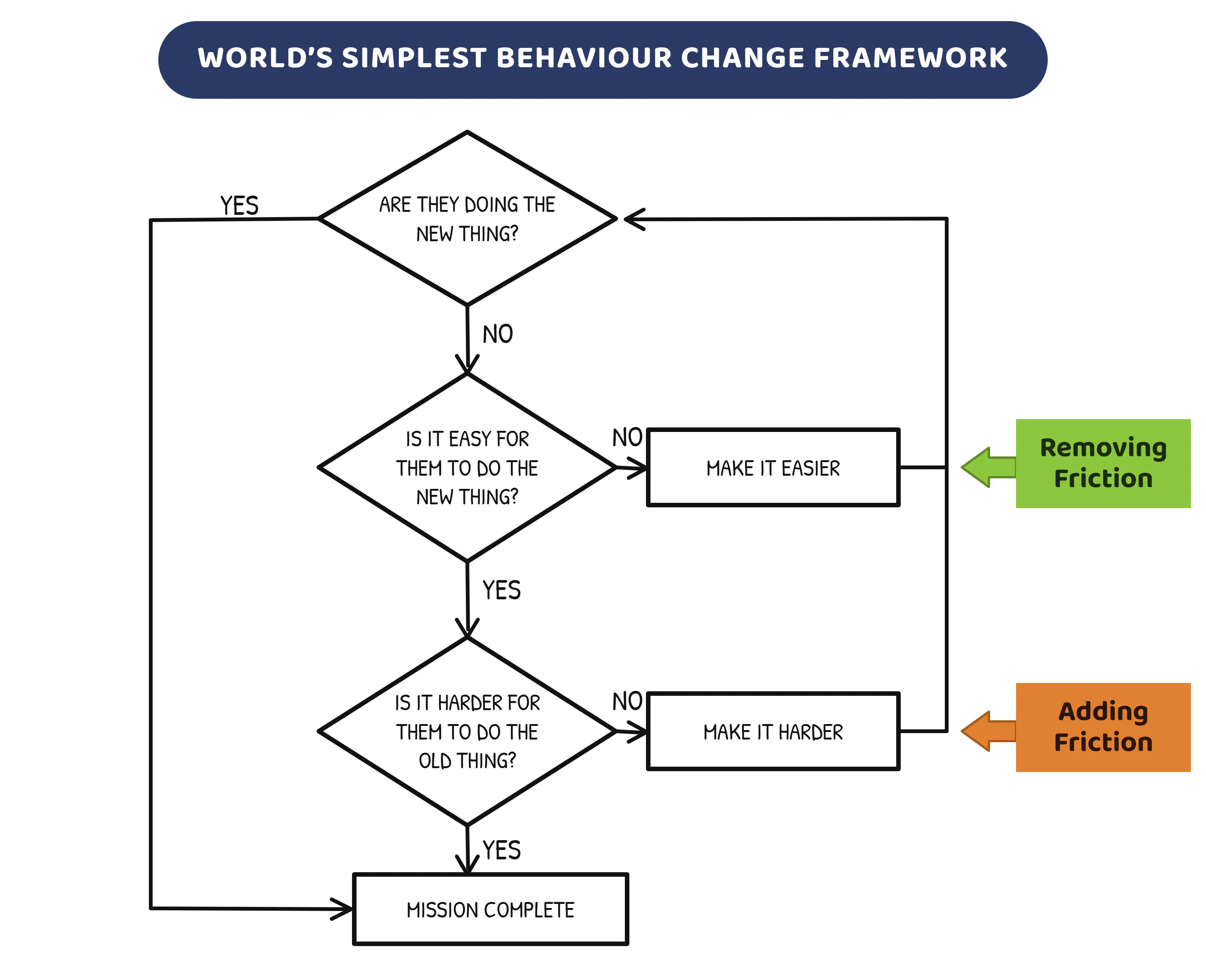
All any organisation cares about is whether people are doing the new thing. If the answer is no, the first question should not be whether to run more communications and training.
- If it is not easy to do the new thing, make it easier. That is removing friction
- If it is already easy, the next question is whether it is harder to do the old thing
- If the old way is still easy, make it more difficult. That is adding friction, then observing
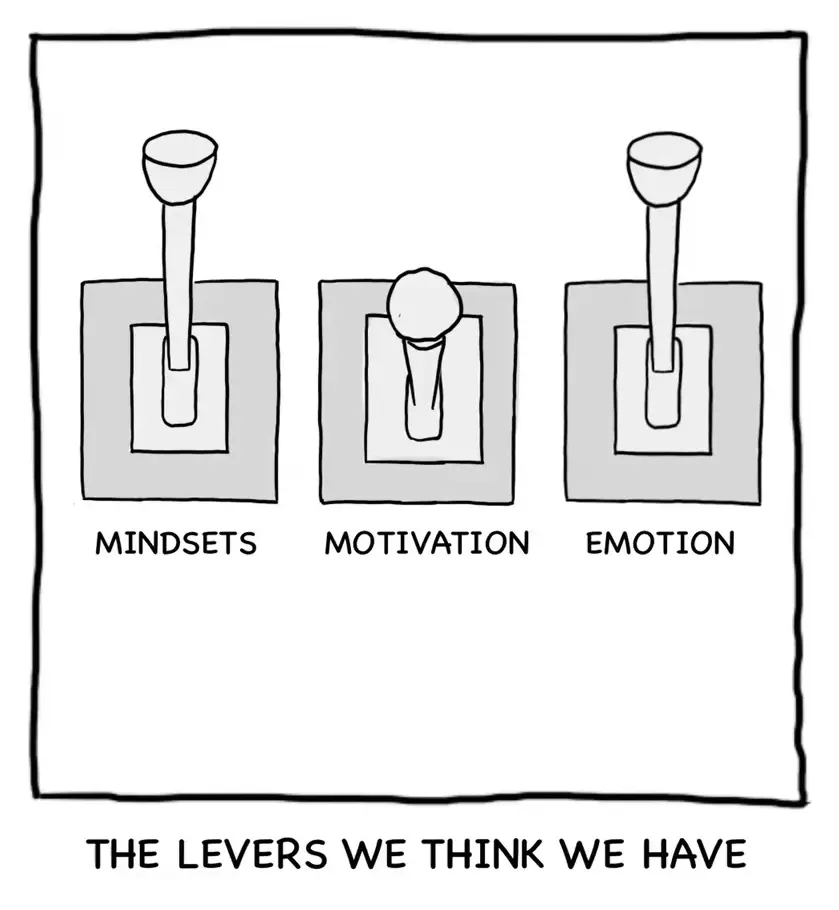
Manage constraints, not mindset, emotions or motivation
Mindset, emotions and motivation matter. They are simply not things we can directly control. There is no lever in your head that anyone can reach in and switch. If there were, we would all pull it and change would be easy.
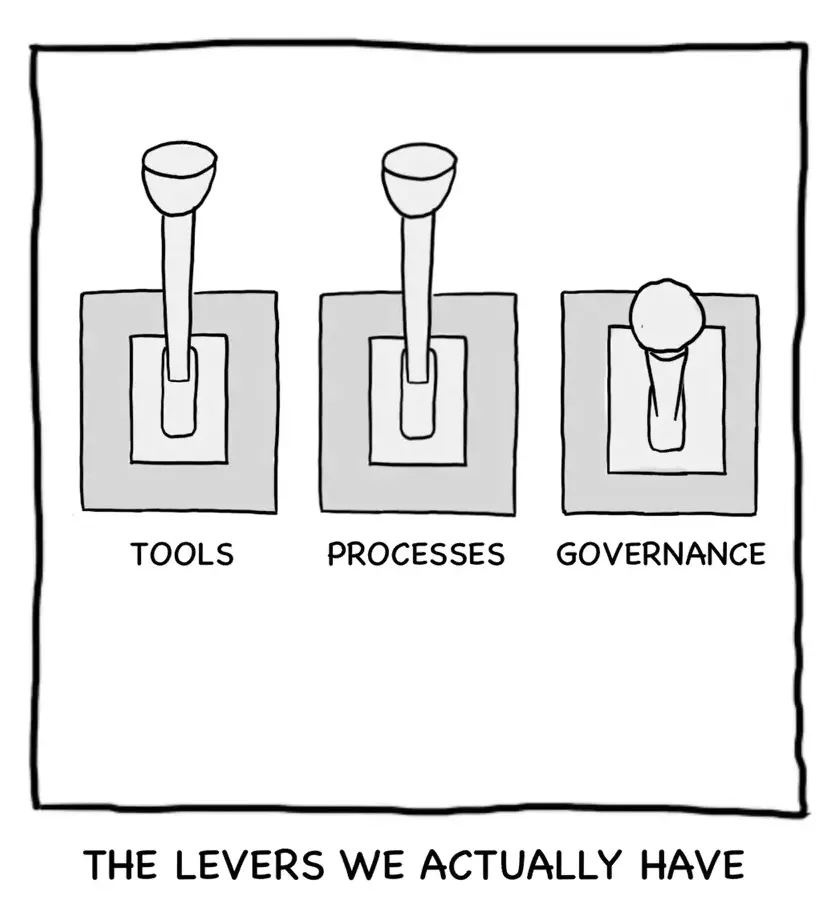
The levers we actually have are constraints: tools, processes, governance. These are tangible and we could control them if we chose to. Whether people like a change is a symptom of the conditions in the environment, and we do them a disservice when we treat the symptom rather than the cause.
So we focus on what we can control around how people feel: decision authority, complexity, autonomy, workload and the rest. If you want to change behaviours, do not try to change behaviours. Change the constraints in the system, then step back and wait to see whether the behaviours you want start to emerge.
To change behaviour, create a behavioural gradient
Change is nothing more than the opening and closing of a behavioural gradient.
ΔBehaviour = Fc − Fd
Friction on the current behaviour minus friction on the desired behaviour.
When friction on the current behaviour is greater than friction on the desired behaviour, behaviour rolls towards what you want to see. When it is lower, you get the opposite, and behaviour becomes variable and intermittent, taking hold in some places and not others.
Water finds the low ground, and behaviour finds the lowest ground in terms of energy expenditure. Lift the current behaviour and you create the gradient. The reverse is equally real. We put people into systems that actively reward a different way of working, then ask them to flow uphill. The map makes that visible.
Building a friction map in six steps
The scenario is a real one. A corporate travel booking tool has been live for nine months. Seventy per cent of trips are still booked outside it, and training was run more than once. You could cut and paste most change initiatives into it.
1. Define outcomes
Define the change in terms of outcomes, current and desired, before placing anything. Seventy per cent of trips booked outside the tool today, ninety five per cent or more through it by next quarter. That is measurable. Three to five outcomes is usually enough. Do not boil the ocean.
2. Define behaviours
Define the change by the specific behaviours you need across leadership, manager and frontline.
- Frontline: book all travel through the tool
- Manager: check a booking went through the tool before approving the expense
- Leadership: book their own travel through the tool, and back the policy publicly
Apply the video test. If you were videotaping somebody, could you see it happening? Asking leadership to be a good sponsor fails. Aim for three to five of the highest leverage behaviours only. The levels matter because a behaviour missing at one is usually caused by something missing at another.
3. Identify constraints
Now ask how the things that exist in the system today either enable or restrict the behaviours you want, because communications and training do not change the system. In the travel scenario the room raises seven:
- A separate login for the travel tool, with no single sign on
- Expense reports approved regardless of where the travel was booked
- Loyalty miles earned by booking direct rather than through the tool
- A tool that misses routes and fares people can find elsewhere
- Executive assistants already booking all executive travel through the tool
- Staff feeling the tool is a Big Brother surveillance thing
- People not liking the new tool
4. Map the constraints
Every constraint goes through four questions, and the first two are gates. Run the travel constraints through them and the map clears fast. People not liking the tool comes off. Big Brother comes off. Loyalty miles come off, because you cannot shut down other websites.
- Does it exist today? If no, it comes off the map
- Can you change it directly? If no, it comes off the map
- Does it impact friction on the current behaviour? This sets its horizontal position
- Does it impact friction on the desired behaviour? This sets its vertical position
You are mapping the system as it exists today, not as you want it to be. Imagine your initiative has been accelerated and goes live next week, communications done, training done. How successful would it be? The map in its current state shows how much of the work sits outside communications and training.
The horizontal axis is friction on the current behaviour and the vertical is friction on the desired behaviour, deliberately inverted, and that inversion creates the zones.
- Steep gradient: the new way is hard and the old way is easy, so the whole system is forcing people to fight for the behaviour you want
- Low gradient: the new way is easy and the old way is hard, so behaviour flows where you want it
- Variable gradient: adoption is intermittent and takes hold in pockets. Everything easy means people have a choice and go with what they know. Everything difficult is what happens when the old system is sunset before the new one is on
- Neutral zone: for constraints that affect one axis but not the other
5. Indicate effort to shift
Categorise each constraint as low, medium, high, fixed or protect, always framed by your timeline. Could you change this in the six months you have? Single sign on could probably be done in a day. Improving the tool takes programming, risk and money. The executive assistants item is a protect, because it is working for us.
6. Adjust the gradient
Pair each constraint with an intervention and forecast the shift. Enabling single sign on drops the friction on the new way. For expense reports there is the nuclear option: stop paying people who do not use the tool. That moves it from steep to low immediately, and will do more for adoption than all the communication and training combined. There is a lot of friction in paying for a trip out of your own pocket, and it is the cognitive load of explaining it at home.
What you end up with is a series of paired constraints, a bad one now matched with a good one, and the change plan builds out from there.
The AI powered friction map
Learning the analogue version first matters, because it teaches the mechanics. After that, AI becomes a thinking partner rather than the driver of the thinking. The AI powered map works the same way, with outcomes at either end and behaviours in the middle.
- AI place: add a constraint and let the tool run the four questions. Enter people do not like the new tool and it responds that this names a stance, mood or opinion rather than something the organisation can act on, then asks what concretely makes the old way easier or the new way harder
- Suggest constraints: give it the context and it proposes system factors you may have missed, such as no pre approval or booking stage gate existing, so managers only see it afterwards
- Suggest interventions: the first option is always the nuclear one, with its anticipated impact and its political and cost reality attached
Terrain mode turns the map into a topographic view, with tightly packed contours marking the steep gradient. Switch to the shifted view and you see the impact of your interventions, with the low gradient forming an actual basin that behaviour will flow towards whether you communicate and train any further or not.
The question to ask leaders
When a leader sees their map and asks whether it can be done, there is one question to put back to them: what are you willing to accept? The nuclear option gets you what you want immediately, but it carries disruption. Are you willing to accept that politically? Do you have the support? Friction mapping often shows that just because something is right for adoption, it still might not be the thing you want to do.
Treat the map as a forecast
It can look easy on paper, but the map is a forecast. Treat every intervention as an experiment and run short, small experiments to see whether it is moving the needle. Change the constraints, step back, and wait. If the behaviour you want does not start to happen, try something else. The map is a living tool, meant to be iterated on over time.
The environment is the biggest factor we have, friction is the biggest lever, and friction mapping is what helps you work with both.
The full session includes the live build of a map in the AI powered tool, and an extended question and answer discussion covering how to friction map in discovery when confidence is low, how to treat time and cost as constraints, and how to get buy in from leaders.
Catch up on the session
Watch the recording and download the resources.
View event recording
Download event resources